A lot of Meshi's web lookups serve one narrow job: someone mentions a person, and the agent needs that person's LinkedIn profile, not someone with the same name. A right answer grounds the rest of the conversation; a wrong one has the agent describing a stranger. Speed, result counts and price, the usual benchmark measures, do not say which engine gets this right. So we built a test set with a verifiable answer and ran five search configurations against it on 16 September 2026.[1] Exa and Google tied near 90%, and for people with no findable profile every engine usually returned someone else.
The test
We drew 200 LinkedIn profiles at random (seeded) from records in Meshi's own systems: people seen in the last 90 days with at least two positions on file.[2] Each person was queried three ways:
- name and current company:
"Jane Doe" Acme Corp - name, title and company:
"Jane Doe" VP Engineering Acme Corp - name and previous company:
"Jane Doe" Former Employer Inc
Two harder sets ran alongside: 40 pairs of real people who share a name but not an employer, and 40 people our import pipeline had given up on and a model-driven web search also could not find, so we believed they had no profile.[3] Returning the other twin is wrong, and so is returning a profile for the second set.
Each query held only a name, an employer and sometimes a job title, the same shape as the lookups our product makes in normal operation. No contact details, messages or member content went to any vendor, and we publish aggregates only. A hit is an exact username match, percent-decoded and lower-cased, with no redirect following, and every call counts in the denominator.[4]
The five configurations, each scoped to LinkedIn people the vendor's own way:
- Google through RapidAPI and Google through Apify: Google SERP APIs with
site:linkedin.com/inappended. One engine, two vendors. - Exa: people search (
category: people) restricted to linkedin.com, with the name sent unquoted. - Parallel:
fastmode with a LinkedIn source policy and a find-the-profile objective. - Tavily:
basicdepth with a LinkedIn domain filter.[5]
Vendors ran in parallel, one call at a time each, at most one call per second.
Finding the right person
How often each configuration ranked the right profile first, given the person's current employer and, in the open circle, their previous one:
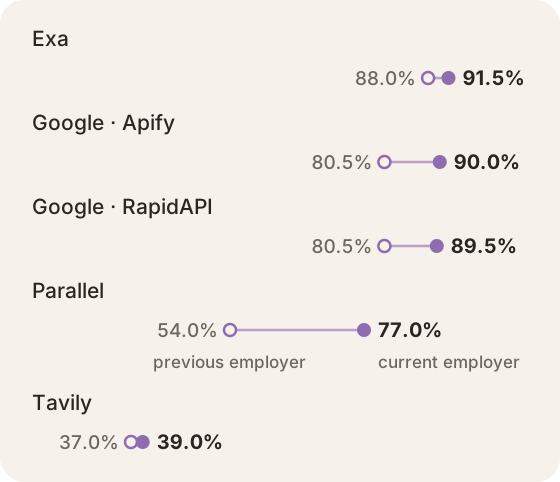
Exa and both Google routes are tied.[6] With the previous employer, Exa's lead over Google holds up in a paired comparison.
Adding the title helped Parallel (+8.5) and Tavily (+6.5) and made no clear difference
for Google and Exa (−1.5 to −2.5). Parallel is stronger at rank five than at rank one:
under name and company its top five held the right profile 93.5% of the time, level
with Exa's 92.5%, and it put the right profile second for 24 of the 200 people.
Re-rank its top five yourself and it competes at one seventh of Exa's price. Tavily
ranked LinkedIn /posts/ and /pub/dir/ pages above profiles (137 and 43 of its
rank-1 results across 600 calls, when the profile was further down), and 31% of the
URLs it returned were not on linkedin.com.
Eleven people were ranked first by no configuration under name and company, and ten of them appeared in no engine's results at all. Three have abbreviated names in LinkedIn's own data, one had renamed their profile URL, and two look like duplicate profiles. That puts the practical ceiling for exact-username matching on this data near 96%, within five points of the best engine, and it is why stacking engines adds little: Exa plus either Google route reaches 93.0%, Exa plus Parallel 93.5%, all five together 94.5%. They miss the same people.
Same-name twins rarely fooled anyone. At rank 1, Exa returned the wrong twin in 4 of 80 calls, each Google route and Parallel in 1, Tavily in none. The one case four configurations missed is a duplicate profile with the same name, title and company. Exa's other three were at a different company, which suggests its people search weights the name above the company term.
When the right answer is nobody
For the 40 people we believed had no profile, how often each configuration still ranked someone's LinkedIn profile first:
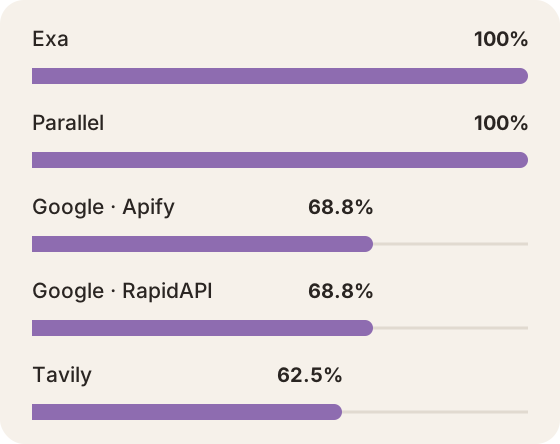
Exa and Parallel never came back empty. By hand, nearly all their answers were someone else with the same name and an unrelated career; 3 of the 40 later turned out to be findable. Google returned nothing for 25 of 80 calls. Tavily had a profile in its top five for 77.5%.
The engines with the best recall are the ones most willing to hand you a stranger. The search call is a candidate generator, not a resolver: something downstream has to compare the candidate's title, company and location with what you already know, and be willing to say "no match". Our import pipeline already did, with a name-similarity pre-filter and then a language-model judge. This benchmark is why we kept the judge as a hard gate.
Speed
Seconds per lookup across all 760 calls each, median and 95th percentile:
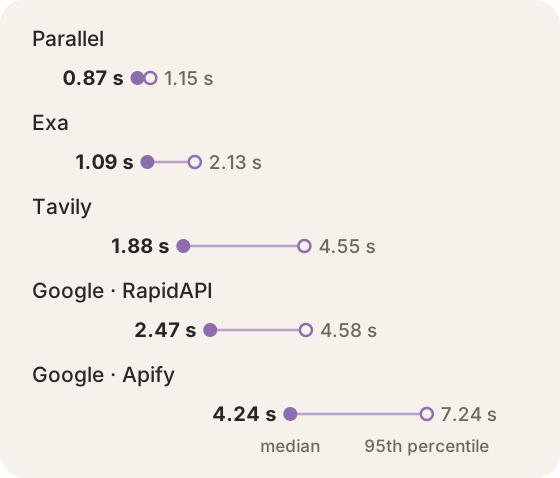
Exa was the only engine to match Google's accuracy, at less than half the median time. Parallel was faster still and 14.5 points worse at rank 1. The two Google vendors returned the same rank-1 result in 587 of 600 positive calls; Apify probably runs a scraper synchronously, and its slowest call took 31.6 s. List prices per 1,000 lookups in September 2026: Parallel $1, Exa $7, Tavily $8, Apify $0.50 (one results page per lookup); RapidAPI is a monthly plan.[7]
The provider looked like a minor part of our latency. In a small sample of production
lookups from the previous 30 days the median was 6.4 s, against 2.7 s for the raw Google call in a
separate 22-query test. We never instrumented the gap, but it points at our own
orchestration and formatting around the call. Any search on a voice call would have
had to fit 6 s, the tightest timeout among our voice drivers at the time. The fastest
modes, Exa instant, Parallel turbo and Tavily ultra-fast, returned at a cold median of 0.2
to 0.4 s in a separate speed test that day, though their overlap with Google's results
fell as they got faster.[8] A faster vendor alone might not have made that
lookup fit voice, since the unmeasured overhead around the call could have eaten the
budget.
API details
Observed in September 2026:
- Exa's people search returned nothing for a quoted name:
"Jane Doe" Acmefound nothing, whileJane Doe Acmefound the right profile first. - Repeat calls measure the vendor's cache. Exa, and Tavily's
fastandultra-fastmodes, returned repeats in about 75 to 110 ms; Google through RapidAPI returned byte-identical results 35 minutes later in 139 ms. Parallel'sfastandturbomodes showed no repeat speed-up. Report the first cold observation. - Apify's synchronous SERP actor returns HTTP 201 with an array of pages, takes its result limit as a string, and wants an upper-case ISO country code.
- Exa's domain filter held at 100% and Parallel's at 99.7%; Tavily's basic tier let 31%
through. One of Exa's documentation pages now says
includeDomainsis rejected withcategory: people. It worked for us in September, so re-test before copying this setup.
Since September
As of November 2026, the agent's live web lookup has moved from a Google SERP to Exa;
the switch came within days of the benchmark, using Exa's
fast mode rather than the configuration benchmarked here, with a Google SERP as the
fallback when Exa fails. A separate LinkedIn people lookup on Exa's people search
returns ranked candidates with evidence, so the agent weighs them instead of trusting
rank 1.
Bulk imports went the other way. They stayed on Google results through a SERP vendor, with the candidate judge as the gate. Exa was briefly a second step there and still serves onboarding, where speed matters most.
Building the no-answer set had a side effect. Of the 60 people our resolver had given up on, 18 looked findable: 14 with a matching role or company and 4 more plausible on name and industry alone. A later three-source check of 58 of them put the findable share at 18 of 58 (31%). Our automated pipeline recovered only 3 of those 18 on its own; most of the rest went to human review.
To reproduce this, you need a ground-truth set with an exact answer drawn from your own data, three masks that vary what the engine sees, a same-name set, and a carefully checked empty set (ours still leaked 3 of 40). The empty set is the one that changes decisions.
Footnotes
-
The run took 58 minutes on the evening of 16 September 2026, Pacific time (17 September UTC): 3,800 calls, zero errors. Vendors change quickly, so re-measure before relying on these numbers. ↩
-
Mostly event-industry professionals whose profiles Meshi already holds, and the company in each query comes from the same profile the engines index. These queries are cleaner than most real lookups, so treat the results as a ceiling for the person-plus-company case. ↩
-
Each was checked with a handful of searches (typically two to four), and any plausible profile disqualified them, leaving 40 of 60 candidates. A later three-source check found 3 of the 40 do have a profile. They are 40 people queried twice, not 80 independent cases, so treat the no-answer rates as indicative. ↩
-
Exact matching undercounts renamed profiles. A secondary match on LinkedIn's numeric suffix would have credited the one provable case. ↩
-
One configuration per vendor, the workhorse tier. Exa
deep, Paralleladvancedand Tavilyadvancedwere not in this run. At September 2026 list prices they cost 1.7×, 5× and 2× the modes we tested, and they are slower: Exa documentsdeepat 4 to 15 s, and Paralleladvancedtook about 4 s in our speed test against 0.9 s forfast. Tavily ran on a development-tier key. ↩ -
95% intervals are about ±4 points per cell for Exa and Google at 200 people, up to ±7 for Parallel and Tavily, about ±10 for twin rates over 80 calls, and about ±14 for the no-answer rates, which rest on only 40 people. ↩
-
Tavily is cheaper on monthly plans. The run cost about $12.50 in per-call charges at list prices (Exa's figure is the one it reported), excluding the RapidAPI plan. ↩
-
Exa now lists
instantas a legacy type. ↩